
PAU-Farm Advisory Service Centre organizes farmers’ training camp on balanced use of fertilizers at village Bharur
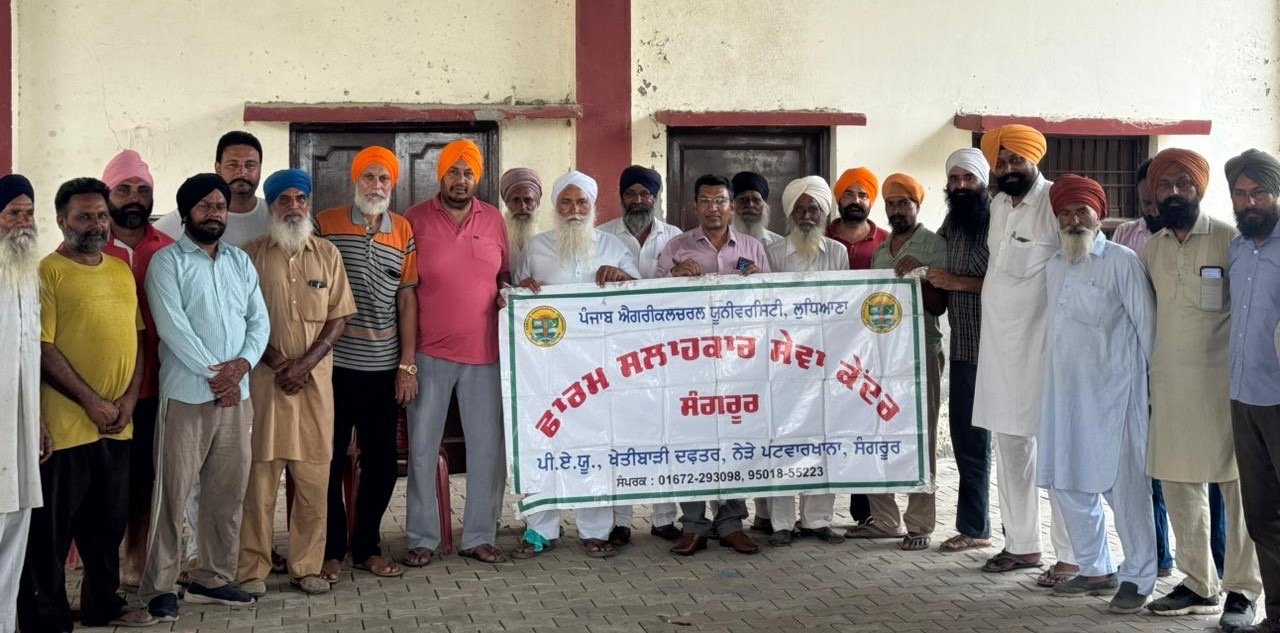
With the objective of promoting soil health, reducing cultivation costs, ensuring the scientific management of poor-quality irrigation water, and encouraging the balanced use of chemical fertilizers, the Farm Advisory Service Centre (FASC), Sangrur, under the guidance of Punjab Agricultural University (PAU), Ludhiana, organized a farmers’ training camp at Village Bharur. Around 50 farmers participated in the programme.
While presiding over the camp, Dr. Ashok Kumar Garg, Senior Extension Scientist (Soil Science), emphasized the importance of soil test-based fertilizer management, the use of biofertilizer inoculants in paddy and basmati nurseries, and avoiding the unnecessary application of phosphorus fertilizers in rice cultivation. He informed the farmers that balanced fertilizer use not only reduces the cost of cultivation but also improves crop productivity and soil health.
Dr. Garg also delivered a detailed lecture on the management of poor-quality irrigation water. He explained that continuous use of saline water can adversely affect soil health and productivity. Such water may be used after mixing with canal water wherever possible.
Similarly, sodic water containing sodium carbonate or bicarbonate can be made suitable for irrigation through the application of gypsum. He stressed the importance of getting tube-well water tested from a soil and water testing laboratory to identify the nature and extent of water quality problems before its regular use in agriculture.
He urged farmers to avoid the unnecessary use of DAP fertilizer in paddy and basmati and to apply urea only as per PAU recommendations. He specifically advised farmers against the common practice of applying two to three bags of urea before puddling. Farmers were also advised to apply zinc only in the recommended quantities to correct zinc deficiency in paddy fields.
Highlighting the importance of bio-fertilizers, Dr. Garg informed the participants that Azospirillum inoculation in paddy nursery not only contributes to higher crop productivity but also plays a significant role in improving the biological health of the soil.
He also provided detailed information regarding the recommended fertilizer schedule and other management practices for raising a healthy paddy nursery.
During the camp, Dr. Garg also discussed the identification and management of paddy dwarf disease in nurseries and encouraged farmers to regularly monitor their nursery crops for early detection of disease symptoms.
The successful organization of the camp was supported by Balwinder Singh and Gurpreet Singh (Sarpanch). On this occasion, Azospirillum inoculants were distributed among farmers as demonstration samples. Agricultural literature was also made available for sale.
The farmers actively participated in the interaction session, and their queries on various agricultural issues were addressed scientifically and systematically.