
Samudra Manthan – National Offshore Exploration Scheme

A New Chapter in Offshore Exploration
Energy powers every aspect of modern life. It fuels homes, farms, industries, transport, and the wider economy. As India continues its rapid growth, ensuring a reliable, affordable, and secure energy supply has become a national priority. While the country’s energy needs continue to rise, a significant share of its crude oil and natural gas requirements is met through imports. Expanding domestic production is therefore essential to strengthen energy security, reduce import dependence, and conserve valuable foreign exchange.
Among the country’s key energy resources are hydrocarbons—organic compounds made of hydrogen and carbon. They occur deep below the land and the seabed. Crude oil and natural gas are the widely used hydrocarbons. They provide the raw material for petrol, diesel, LPG, petrochemicals, fertilisers, and numerous industrial products.
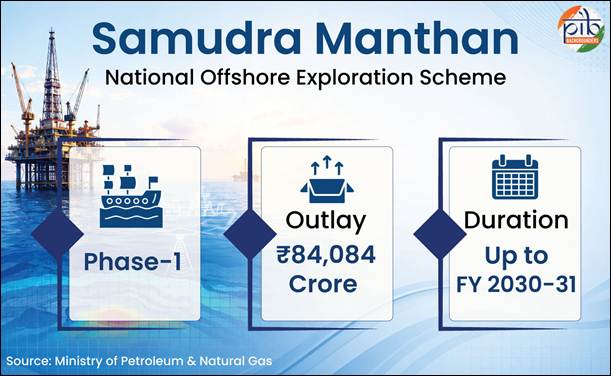
India’s offshore basins hold vast untapped hydrocarbon potential. A basin is a large natural depression in the earth where hydrocarbons collect. Unlocking these resources requires modern exploration, reliable geological data, advanced drilling capabilities, and a strong domestic supply chain. To accelerate this effort, Samudra Manthan – the National Offshore Exploration Scheme has been approved on 31 July 2026. With a Phase-I outlay of ₹84,084 crore up to FY 2030‑31, it aims to boost the hydrocarbon exploration and production sector.
Why The Seas Hold the Key for India
India is the world’s third-largest consumer of crude oil. Its annual import bill is nearly USD 144 billion, or about ₹13 lakh crore. Recent global events have shown how vital uninterrupted energy access is. Higher domestic output has thus become critical for a rapidly growing economy.
The Offshore Opportunity
Much of India’s future oil and gas potential lies offshore. Deepwater and ultra-deepwater basins are sea zones with very high-water depth. India’s eastern and western offshore basins extend to water depths of up to 3,000 metres. They are estimated to hold over 5,600 MMTOE (Million Metric Tonnes of Oil Equivalent) of hydrocarbon potential. Recent finds in the Cauvery, Mahanadi, and Andaman basins have reinforced this promise.
ONGC’s Fixed Offshore Platform
The Challenge of Deepwater Exploration
Exploration is a costly and patient activity. Moving from the award of an exploration block to commercial production typically takes 5–10 years. A single deepwater exploratory well costs about USD 125–150 million. Such high stakes can discourage offshore exploration.
There is another reason why constant search matters. Existing fields witness a natural decline of around 6–7 percent every year. New discoveries are needed simply to sustain current output. Sustained exploration thus serves as a path to lasting self-reliance in energy.
Inside the Samudra Manthan Mission
Samudra Manthan marks the transition from policy reform to mission-mode implementation. The scheme adopts a risk-sharing approach to attract sustained investment into frontier waters. It seeks to de-risk offshore ventures and encourage private capital, building enduring national capability across the value chain. In doing so, it converts a decade of reform into concrete action at sea.
Components of Samudra Manthan
Offshore exploration depends on reliable data, advanced technology, modern infrastructure, and a resilient supply chain. Samudra Manthan brings these elements together through four components.
- Seismic Data Acquisition, Processing, and Interpretation
Limited offshore seismic coverage restricted the identification of drill-ready oil and gas prospects. The scheme funds large-scale 2D and 3D seismic surveys with an outlay of ₹28,534 crore. Advanced technology and Artificial Intelligence will speed up processing and interpretation. Older data in the National Data Repository will also be re-processed with modern tools.
- Accelerated Offshore Exploration
High cost and long gestation make deepwater drilling a risky venture. To share this risk, the scheme allocates ₹43,200 crore for drilling 60 deepwater and ultra-deepwater wells. Financial support covers up to 50 percent of eligible drilling cost, or ₹675 crore per well, whichever is lower. The scheme is open to both public and private Exploration and Production (E&P) operators to increase oil and gas reserves. It will accelerate reserve accretion and unlock India’s deepwater potential.
- Common Offshore Infrastructure
Many offshore discoveries remain unproduced due to costly infrastructure, particularly in the Mahanadi and Kutch basins. The scheme provides ₹10,000 crore for shared production and evacuation facilities in select basins. Common infrastructure lowers project costs and turns idle finds into producing fields.
- Oil and Gas Manufacturing and Services Zone
Low domestic manufacturing increases exploration costs, import dependence, and foreign exchange outflow. In view of this, an integrated Oil and Gas Manufacturing and Services Zone will be established with ₹2,000 crore. It will build domestic capabilities in manufacturing, repair, warehousing, engineering, and services. This directly advances Make in India across the supply chain. An amount of ₹350 crore supports monitoring, digital interventions, evaluation, human resources, awareness and outreach, events, and media.