India’s Rivers Turning Into Sewage Channels? 271 Rivers Have Polluted Stretches — Where Is Government Accountability?
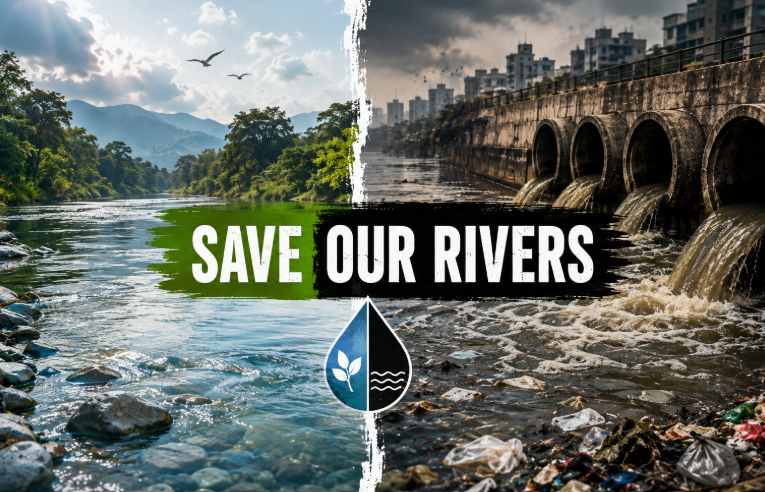
India’s rivers are supposed to be the lifelines of the country — providing water for drinking, agriculture, industry and ecosystems. Yet across large parts of the country, many rivers are increasingly being forced to carry something they were never meant to carry: untreated sewage, industrial effluents, chemical waste and urban garbage.
The latest Central Pollution Control Board (CPCB) assessment presents a serious warning. Of 623 rivers assessed, 296 polluted stretches were identified across 271 rivers in 32 States and Union Territories. While the number of polluted stretches has fallen compared with previous assessments, the existence of hundreds of polluted stretches shows that India’s river-cleaning challenge is far from over.
The uncomfortable question is not simply why people are polluting rivers.
The bigger question is: How are untreated sewage and industrial waste still being allowed to reach rivers in the first place?
Are Sewage Pipes Being Connected Directly to Rivers?
In many Indian cities and towns, wastewater first enters drains and then eventually reaches rivers or other water bodies. Where sewage-treatment and interception infrastructure is inadequate, poorly maintained or insufficient for the volume generated, untreated or inadequately treated wastewater can become a major source of river pollution.
The problem is so serious that environmental authorities and courts have repeatedly focused on stopping untreated sewage from entering natural water bodies.
The National Green Tribunal has recently dealt with cases involving alleged untreated sewage and wastewater discharge into the Yamuna. In one matter, authorities were asked to respond to allegations concerning sewage flowing from Vrindavan and Kosi into the river.
This raises a basic governance question:
If a city knows where its sewage drains are, why is that sewage allowed to reach a river without adequate treatment?
The Yamuna: A Symbol of Administrative Failure
The Yamuna is perhaps the clearest example of the contradiction between government promises and ground reality.
Millions of rupees and years of government programmes have been devoted to cleaning the river, yet heavily polluted stretches continue to make headlines.
The issue is not simply that people throw garbage into the river. A far bigger problem is the management of wastewater generated by cities along the river.
If sewage is collected through drains, it should be intercepted, diverted and treated before entering the river.
A river should not be treated as the city’s final sewage outlet.
Ganga: Massive Infrastructure, Massive Challenge
The Ganga has received enormous government attention through programmes such as Namami Gange. There has been measurable improvement in several stretches, and the latest CPCB assessment also shows an overall reduction in polluted river stretches.
But the problem remains substantial.
Recent RTI-based reporting citing CPCB data found that five major Ganga-basin states — Uttarakhand, Uttar Pradesh, Bihar, Jharkhand and West Bengal — collectively generate about 11,785.5 million litres of sewage per day, while their combined treatment capacity is around 8,026.7 million litres per day. That represents a major treatment-capacity gap.
In simple terms, if cities produce more sewage than their treatment systems can handle, some of that waste inevitably creates pressure on drains, rivers and other water bodies.
That is an infrastructure and governance failure — not merely a citizen-behaviour problem.
Gomti: Why Wait Until 2044?
The Gomti is another example of how long India’s river pollution problems can remain unresolved.
The Uttar Pradesh government has reportedly set 2044 as a target to completely stop untreated sewage flowing into the Gomti, with plans involving additional sewage-treatment infrastructure and upgrades.
But this raises another uncomfortable question:
Why should a river have to wait nearly two decades for the complete elimination of untreated sewage?
Long-term infrastructure planning is necessary, but rivers cannot simply pause their ecological decline while governments wait for future deadlines.
Musi, Hindon, Mithi and Other Rivers
The problem is not restricted to the Ganga and Yamuna.
The Musi River in Telangana, the Hindon in Uttar Pradesh and Mumbai’s Mithi River have all faced severe pollution problems associated with sewage, industrial waste and urban development. The Hindon, for example, has been described as severely degraded because of industrial effluent and inadequate sewage-treatment infrastructure.
Other polluted river stretches are spread across states including Maharashtra, Kerala, Tamil Nadu, Uttar Pradesh, Karnataka, Telangana, Rajasthan, Madhya Pradesh, West Bengal and several others.
The CPCB’s national assessment makes clear that this is not the problem of one city or one political party. It is a countrywide governance challenge involving central agencies, state governments, municipal bodies, pollution-control authorities and industries.
Where Is the Government Failing?
There are several areas where accountability needs to be much stronger.
1. Sewage treatment capacity is still inadequate
Cities are expanding rapidly, but sewage infrastructure has often failed to keep pace.
Building a sewage-treatment plant on paper is not enough. The plant must have sufficient capacity, receive the sewage it was designed for, function properly and meet treatment standards.
2. Drains need to be intercepted before reaching rivers
A sewage drain ending at a river is not a solution.
The government needs to ensure that major drains are mapped, monitored and intercepted before their wastewater reaches natural water bodies.
Environmental experts have specifically highlighted interception and diversion systems as an immediate way of preventing untreated sewage from entering rivers while larger sewerage systems are developed.
3. Pollution-control enforcement cannot remain weak
Industries that discharge untreated or inadequately treated effluent must face meaningful consequences.
A system in which violations are detected but penalties remain too weak to change behaviour effectively becomes an invitation to pollute.
The NGT has repeatedly intervened in pollution cases, including matters involving untreated effluent and damage to water bodies.
4. Governments must publish accountability, not just targets
Every polluted river stretch should have publicly available information showing:
- Which drains are entering the river
- How much wastewater each drain carries
- Whether the wastewater is treated
- Which sewage-treatment plant is responsible
- Whether the plant is actually operating
- Who is responsible for monitoring it
- What deadline has been fixed for eliminating the discharge
- What action has been taken against violations
Without this information, river-cleaning campaigns can become little more than announcements and targets.
The Real Question: Who Will Be Held Responsible?
India already has environmental laws, pollution-control authorities, monitoring systems and large river-cleaning programmes.
The CPCB monitors thousands of locations across the country, including hundreds of rivers, to assess water quality.
So the country does not simply have a knowledge problem.
It has an implementation and accountability problem.
Authorities know where many polluted stretches exist. They know the major pollution sources. They know sewage-treatment infrastructure is essential.
Yet untreated sewage continues to threaten rivers.
That is why governments — at the central, state and local levels — must answer a simple question:
If we know the sewage is entering the river, why haven’t we stopped it?
A River Is Not a Drain
India cannot seriously talk about becoming a developed economy while allowing rivers to function as open wastewater channels.
Cleaning a river after pollution has occurred is far more expensive and difficult than preventing pollution from entering it.
The priority should therefore be simple:
Stop sewage at the drain. Stop industrial waste at the source. Treat wastewater before discharge. Monitor every major outlet. Publish the data. Penalise violations. And hold the responsible authority accountable.
India’s latest CPCB assessment shows that progress is possible — the number of polluted stretches has fallen substantially compared with earlier assessments.
But hundreds of polluted stretches remain.
India does not need another promise to clean its rivers. It needs functioning sewage systems, strict enforcement and officials who are held responsible when pollution continues.
Because once a river becomes a sewage channel, the damage is not just environmental.
It becomes a failure of governance.